

How to remove fridge odour and stop it coming back

By Urban Company
6 min read
Nov 13, 2026
Remove fridge odour in 4 steps: wipe, deodorise, deep clean, then fix the door seal and drip hole, the 2 spots where a returning smell lives.
It’s Monday night in a Tampines flat. You threw out the forgotten container of curry on Saturday, wiped the shelf, and put a box of baking soda at the back. Two days later, the same sour smell greets you every time you reach for the milk.
Key takeaways
A fridge smell that returns after cleaning is usually coming from the rubber door seal or a blocked drip channel at the back of the fridge floor, not from the food inside.
In Singapore, humidity is the usual cause. Warm, damp air rushes in every time the door opens, condenses on the shelves and collects in the seal and the drainage hole, where mould grows.
Work up in 4 steps: bin and wipe, deodorise, strip and deep clean, then fix the seal and the drip channel.
Baking soda keeps a clean fridge fresh, but it cannot clean one. It masks a mould smell rather than removing it.
Never use bleach inside a fridge — it is a food-contact surface — and never mix bleach with vinegar.
The curry was never the whole problem. Here’s where the smell actually lives.
What causes a fridge to smell?
Most fridge smells start with food, but the ones that stay come from moisture trapped where you don’t clean.
A spill or a mouldy vegetable sets things off; the smell then settles where a quick wipe misses.
Where it lives
Tell-tale sign
Fix
Spoiled food, spills
Strongest at 1 shelf
Bin it, wipe the shelf
Shelves and drawers
Faint smell when empty
Wash, then air-dry
Rubber door seal
Black spots in folds
Clean inside each fold
Drip channel, hole
Water on fridge floor
Clear, flush the hole
Why it’s worse in Singapore:
the usual trigger here isn’t a power cut or a long holiday — it’s humidity. Every time the door opens, damp air gets in and condenses on cold surfaces. If the drainage hole is blocked, that water sits at the back of the fridge floor, going stale.
How do you remove fridge odour, step by step?
Start with the quickest fix and move up only if the smell survives.
Most fridges are sorted by step 2; a smell that keeps coming back needs step 3, then the seal and drip channel below.
Step 1: bin the source and wipe
Take everything out and throw away anything expired, leaking or past its best. Check the backs of the crisper drawers and the door shelves.
Mix 1 tablespoon of baking soda into 1 litre of warm water.
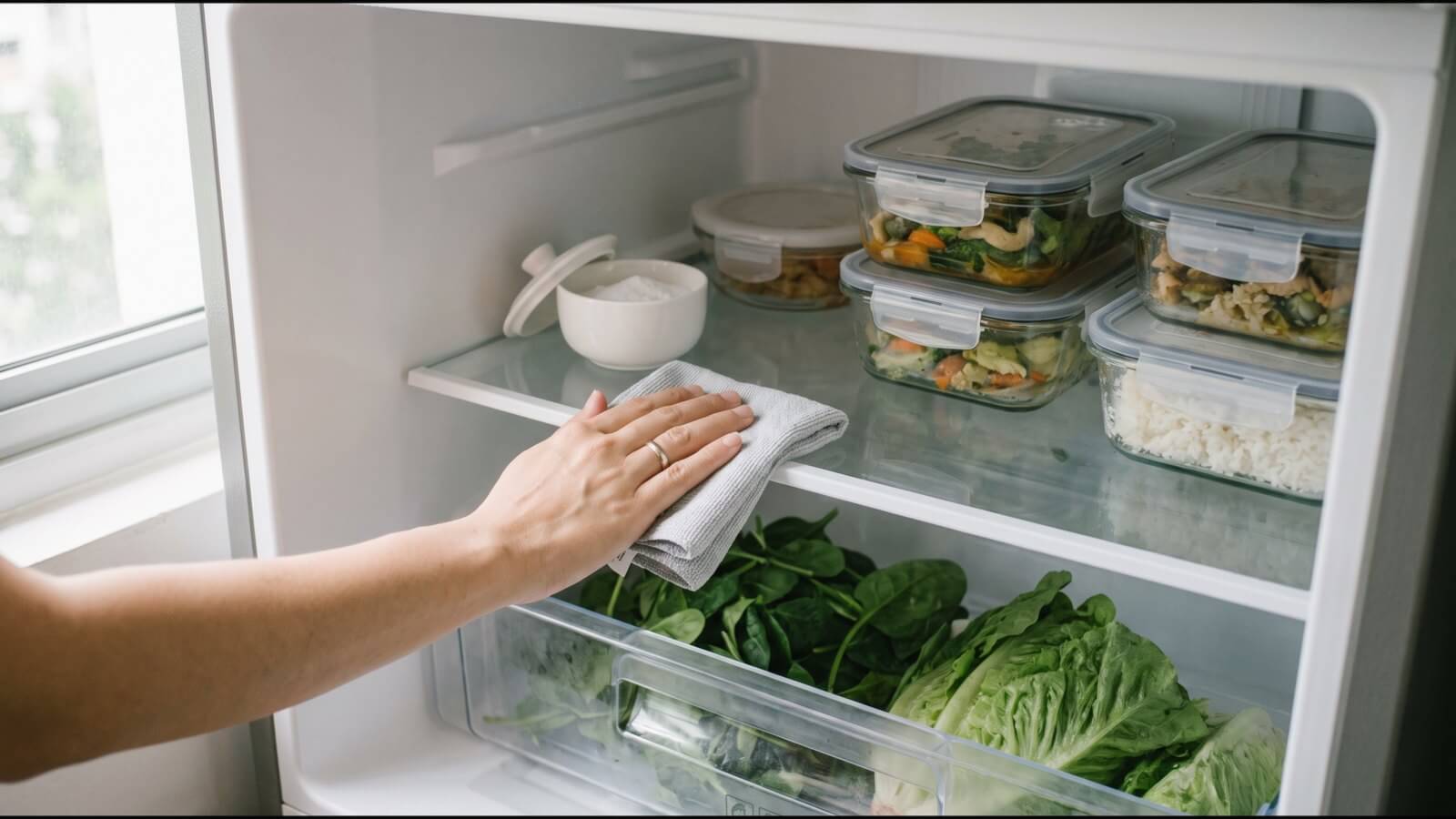
Wipe every shelf, wall and the underside of each shelf with a microfibre cloth dipped in the mix. Dry with a clean cloth.
Step 2: deodorise
Put an open box of baking soda or a sachet of activated charcoal on a middle shelf, where young children can’t reach it.
Step 3: strip and deep clean
If the smell is still there after a day, empty the fridge completely and take out every removable shelf and drawer.
Unplug the fridge, or switch it off at the power point.
Wash shelves and drawers in warm, soapy water — let cold glass shelves warm up first, or they can crack. Air-dry fully; damp plastic holds smells.
Wipe the inside with 1 part white vinegar to 1 part water, then with clean water.
Leave the door open for 15–20 minutes to dry before plugging back in.
Keep your food in a cooler box with ice packs while you work.
How do you clean the fridge door seal?
Open each fold of the rubber seal and clean inside it with a soft toothbrush dipped in warm, soapy water.
The folds trap drips and condensation, and in a humid kitchen they grow mould quickly. Work round the whole door, wipe black spots with diluted white vinegar, leave it for 5 minutes, then wipe clean.
Dry every fold
— a damp seal is where the smell starts again.
If the seal is torn or no longer grips the frame, cleaning won’t fix it: a worn seal lets in more humid air, and the smell returns faster.
Where is the fridge drip channel, and how do you clear it?
On most frost-free fridges, the drainage hole is a small opening at the bottom of the back wall, just above the crisper drawers.
A groove on the back wall guides condensation into it, and from there the water drains to a tray near the compressor, where it evaporates.
When food bits block the hole, water pools under the crisper drawers and goes stale. To clear it:
Unplug the fridge.
Push a pipe cleaner or a long cotton bud gently into the hole and twist to loosen the blockage. Don’t force anything sharp in — the drain tube is easy to puncture.
Flush it slowly with warm water and a little baking soda, using a turkey baster or a syringe.
If water drains away freely, it’s clear.
Your manual shows where the drip tray sits and whether it slides out to wash.
What should you never use inside a fridge?
Never use bleach inside a fridge.
It’s a food-contact surface, and residue lingers on shelves and in the seal.
Never mix bleach with vinegar
— together they release toxic chlorine gas, dangerous in a small HDB kitchen. Skip scented sprays too; your food picks up the smell.
When is it worth getting a Professional?
If the smell returns within days of a full clean, with the seal and drainage hole clear, the problem may be mechanical
—
a fridge not holding its temperature, or a cracked drain tube, needs an appliance repair, not a cleaner. If the job has simply got away from you, or you’ve just moved into a resale flat, a professional clean is a fair call.
Urban Company’s Interior Fridge Cleaning is a complete wipe-down of the shelves, drawers and walls inside your fridge. It takes about 20 minutes and costs
$35
(November 2026).
See Interior Fridge Cleaning and other single-item cleaning services in Singapore.
Frequently asked questions
What is the fastest way to get a smell out of a fridge?
Find and bin the source, then wipe every shelf and wall with warm water and a spoonful of baking soda. Pay attention to the door seal folds and the drainage hole at the back. Leave an open box of baking soda inside afterwards. Most everyday smells are gone within a few hours of a thorough wipe.
Does baking soda really absorb fridge odours?
Baking soda neutralises acidic smells, such as spoiled milk and old leftovers, and an open box helps keep a clean fridge fresh. It cannot clean anything, though. If mould is growing in the door seal or water is sitting in a blocked drip channel, baking soda only masks the smell until the box is saturated.
Why does the smell come back after cleaning?
A smell that returns within days is usually coming from the rubber door seal or a blocked drip channel at the back of the fridge floor, not from food. Moisture collects in both, and in Singapore’s humidity mould grows there fast. Clean inside the seal folds and flush the drainage hole to stop it.
Where is the fridge drainage hole and how do you clear it?
On most frost-free fridges, the drainage hole is a small opening at the bottom of the back wall, just above the crisper drawers. Unplug the fridge, push a pipe cleaner gently into the hole to loosen debris, then flush it slowly with warm water and a little baking soda, using a turkey baster or syringe.
Can you use bleach inside a fridge?
No. The inside of a fridge is a food-contact surface, and bleach residue can linger on shelves and in the rubber seal. Use warm water with baking soda, or diluted white vinegar, instead. Never mix bleach with vinegar either, because the combination releases a toxic chlorine gas, which is dangerous in a small kitchen.
How often should a fridge be cleaned out?
Clear out expired food and wipe up spills once a week, ideally before your weekly grocery run. Do a full clean, with shelves out and the door seal and drainage hole included, every 3 months. Replace an open box of baking soda every 3 months too, because it stops absorbing smells once saturated.
Checkout Our Latest Articles

Social links