

How to clean a shower head and a stained toilet bowl

By Urban Company
7 min read
Nov 15, 2026
A spitting shower head and a brown toilet ring are both limescale. Here is the vinegar soak that clears each one, without removing anything.
It’s Sunday night in a 5-room flat in Punggol. The shower has gone from a steady spray to three strong jets and a sideways dribble, and the brown-orange ring in the toilet has survived two weekly scrubs. Neither is a scrubbing problem. Here is how to fix both in one afternoon.
Key takeaways
A spitting shower head and a brown toilet ring are the same problem: limescale, a mineral deposit left by tap water, not dirt.
Limescale needs a soak, not a scrub. White vinegar dissolves it; scrubbing only polishes it.
A fixed shower head can be descaled in place. Tie a bag of vinegar over it for about an hour, then run hot water through it.
To treat a toilet ring, lower the water first, or the acid is diluted before it reaches the stain.
Never mix bleach with vinegar, toilet cleaner or ammonia. The combinations release toxic gases.
Why won’t scrubbing shift it?
Limescale in a shower head or toilet bowl is a mineral deposit, so it dissolves in a soak of acid such as vinegar. Scrubbing polishes it rather than removing it.
Tap water carries dissolved minerals,
mostly calcium and magnesium. When water evaporates, they stay behind in thin, hard layers: around each nozzle in a shower head, and at the waterline in a toilet. Over time the layer picks up colour from iron and grime, which is why it turns brown or orange.
A brush moves soap scum and dirt, not a crust bonded to the surface. What works is contact time: acid left sitting on the deposit long enough to break it down.
What you see
What it is
What works
Spray jets go sideways
Scale in the nozzles
Vinegar soak, toothbrush
Weak flow after descale
Grit in the inlet filter
Rinse the filter screen
Brown toilet ring
Scale stained by iron
Drain, acid soak, scrub
Pink film under the rim
Bacteria, not minerals
Clean it more often
Bowl won’t drain
A blockage
Call a plumber
How do you clean a shower head without removing it?
Tie a plastic bag of white vinegar over the head, leave it for about an hour, then flush it with hot water.
Many HDB and condo bathrooms have an overhead head fixed to the wall, so for most people this is the method, not a workaround.
Half-fill a sturdy plastic bag with white vinegar.
Lift it over the shower head so every nozzle is under the liquid, and tie it around the arm with a rubber band.
Leave it for about an hour. For heavy build-up on a chrome head, two to three hours is fine.
Remove the bag and run the shower on hot for a minute to push the loosened scale out.
Rub the nozzles with an old toothbrush. If they are soft rubber, press each one with your thumb to crack out the last of the scale.
One caution on finishes.
Brass, gold-tone, matte black or nickel heads can dull in acid. Limit those to 15 to 20 minutes in half-strength vinegar, and rinse well.
What if you can remove the shower head?
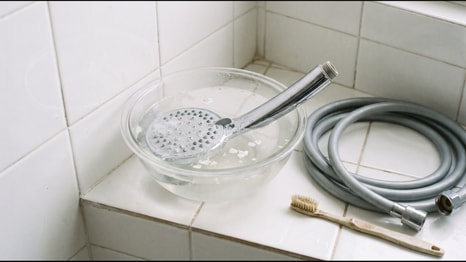
Unscrew it, soak it in a bowl of vinegar for an hour, and check the filter screen while you’re there.
Handheld heads on a hose turn off anti-clockwise by hand. Inside the connector there is often a small mesh screen; if pressure is still weak after descaling, grit caught here is the usual reason. Rinse it, refit it, and don’t overtighten, as that squashes the washer and causes a drip.
How do you remove a stain from a toilet bowl?
Drop the water level, soak the ring in acid for a few hours, then scrub.
Skipping the first step is why most stains survive.
Turn off the small angle valve behind or beside the toilet, then flush. The bowl empties and does not refill.
Pour white vinegar, or an acidic toilet cleaner, over the ring. Toilet paper pressed onto the stain and soaked with vinegar keeps it in contact on the sloped sides.
Leave it for a few hours, or overnight for a thick band.
Scrub with the toilet brush. For what remains, rub gently with a wet pumice stone. Keep it wet the whole time, or it can scratch the glaze.
Turn the valve back on and flush.
Avoid wire brushes and metal scourers. Scratched glaze gives new minerals a rougher surface to grip.
The baking soda and vinegar fizz you see recommended everywhere looks impressive, but the two neutralise each other. For limescale, vinegar alone does more.
Never mix bleach with these
Never mix bleach with vinegar, with toilet cleaner, or with ammonia.
Most toilet cleaners are acidic, like vinegar. Bleach with an acid releases chlorine gas; bleach with ammonia releases chloramine gas. Both can cause serious breathing problems in a small bathroom.
If you have used bleach on the toilet recently, flush several times and wait before adding vinegar. Open the window or run the exhaust fan, and wear rubber gloves for any descaling job.
How do you stop both coming back?
Little and often.
Every few weeks, give the shower head a 30-minute bag soak and the toilet a vinegar pour at the waterline before bed. Thin layers dissolve in minutes; thick ones take hours. The glass shower screen responds to the same logic: see
how to clean water stains on glass.
When is it worth getting help?
When the build-up is on every surface at once, or has gone on for years.
One shower head and one toilet ring are a fair DIY afternoon. Tiles, grout, glass, taps and toilet all needing to be scrubbed back is a different scale of work, and the point where hiring a cleaning company starts to be worth it. If you want to try the tiles and grout yourself first,
our step-by-step bathroom guidecovers the order to work in.
cover different things: a recurring home cleaning visit includes bathroom cleaning, which keeps a clean bathroom clean, but it is not designed to strip years of limescale back.
If the whole bathroom is due a reset, Urban Company’s Bathroom Deep Cleaning starts
from $65
. It uses deep scrubbing with heavy-duty tools to remove stains and buildup, and high-temperature steam disinfection for a germ-free clean.
See Bathroom Deep Cleaning and book in Singapore.
Frequently asked questions
How do you clean a shower head without removing it?
Fill a sturdy plastic bag with white vinegar, pull it up over the shower head so the nozzles sit fully in the liquid, and tie it around the neck with a rubber band. Leave it for about an hour, remove the bag, run hot water for a minute, then rub the nozzles with an old toothbrush.
Does vinegar unclog a shower head?
Yes, when the blockage is limescale, which it usually is. The acid in white vinegar dissolves the chalky mineral deposits that narrow each nozzle. It will not shift grit or a piece of debris trapped behind the face plate. If pressure is still weak after two soaks, check the small filter screen where the head joins the hose.
How do you remove a brown ring from a toilet bowl?
Turn off the small valve behind the toilet and flush, so the water level drops below the ring. Pour white vinegar or an acidic toilet cleaner over the stain and leave it for a few hours, or overnight. Then scrub with the toilet brush. For a stubborn ring, rub gently with a wet pumice stone.
Why does the toilet stain come back so quickly?
Because the minerals that cause it arrive with every flush. Water sits at the same level in the bowl, dries slightly at the edge, and leaves a thin new layer each time. Scrubbing polishes the old layer rather than removing it. A short acid soak every few weeks stops the ring rebuilding into a thick band.
Can you use bleach and toilet cleaner together?
No. Most toilet cleaners are acidic, and acid mixed with bleach releases toxic chlorine gas, even in a small, well-ventilated bathroom. Never mix bleach with vinegar, toilet cleaner or ammonia. Use one product, flush or rinse it away completely, open the window, and wait before using a different one on the same surface.
What does a bathroom deep clean include?
Urban Company’s Bathroom Deep Cleaning uses deep scrubbing with heavy-duty tools to remove stains and buildup, plus high-temperature steam disinfection for a germ-free clean. It is a one-off reset for the whole bathroom, different from the bathroom cleaning included in a recurring home cleaning visit, which keeps a clean bathroom clean rather than restoring a neglected one.
Checkout Our Latest Articles

Social links